Maria Szymanowska
Quick Facts
Born: 14 December 1789, Warsaw, Poland
Died: 24 July 1831, Saint Petersburg, Russian Empire—now Russia
Life and Musical Career
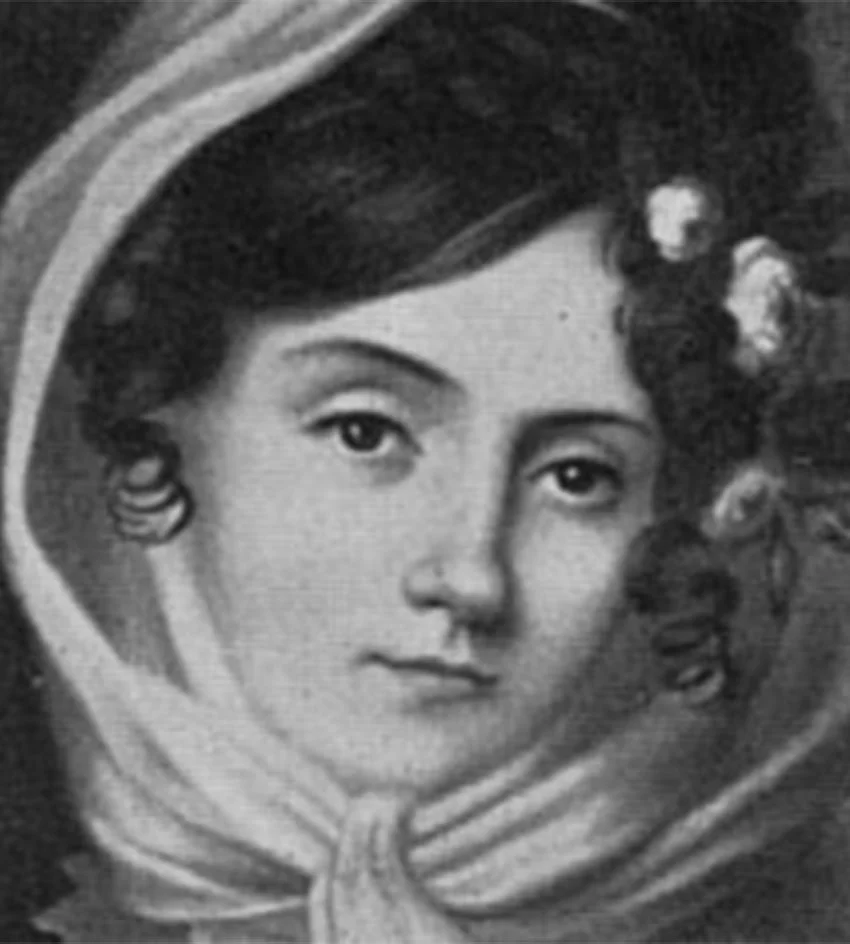
Maria Szymanowska, born Maria Agata Wołowska, was a Polish composer and virtuoso pianist. She was one of the first women in nineteenth-century Europe to establish an international career as a professional concert pianist and is regarded as an important forerunner of Romantic piano music.
Szymanowska showed exceptional musical ability from childhood, improvising on the spinet and clavichord before she could read music. From the age of eight, she studied with Antoni Lisowski and later Tomasz Gremma. Her family’s Warsaw home was visited by prominent musicians, including Józef Elsner, Karol Kurpiński and Franciszek Lessel.
In 1810, she travelled to Paris, where her playing impressed Luigi Cherubini. After returning to Poland, she married Józef Szymanowski and had three children. The couple separated in 1820, after which she devoted herself fully to performing and composition.
Szymanowska toured Russia from 1822 and later performed across Western Europe, appearing in cities including Dresden, Leipzig, Weimar, Paris and London. She met many leading cultural figures, including Johann Wolfgang von Goethe, Felix Mendelssohn and Gioachino Rossini. Tsar Alexander I granted her the title of First Pianist to the Russian imperial court. In 1827, she settled permanently in Saint Petersburg, where she performed, taught and hosted an influential artistic salon.
Her catalogue contains nearly 100 compositions, primarily piano miniatures, including mazurkas, polonaises, waltzes, nocturnes, études and preludes. Her elegant melodies, expressive ornamentation and Polish dance rhythms anticipated several features later associated with Chopin and early Romantic piano music. She died during the Saint Petersburg cholera epidemic at the age of 41.
Three of her most important compositions are:
Vingt exercices et préludes – a collection of twenty études and preludes demonstrating her innovative and expressive approach to piano technique.
Nocturne in B-flat Major – one of her best-known lyrical piano miniatures and an early Polish example of the Romantic nocturne.
Vingt-quatre mazurkas – a major collection inspired by Polish dance rhythms, combining national character with refined salon style.
Sources:
Culture.pl, Adam Mickiewicz Institute — Maria Szymanowska: Biography.
National Institute of Music and Dance — Maria Szymanowska: Biography and Catalogue of Works.
Polish Music Center, University of Southern California — Maria Szymanowska.