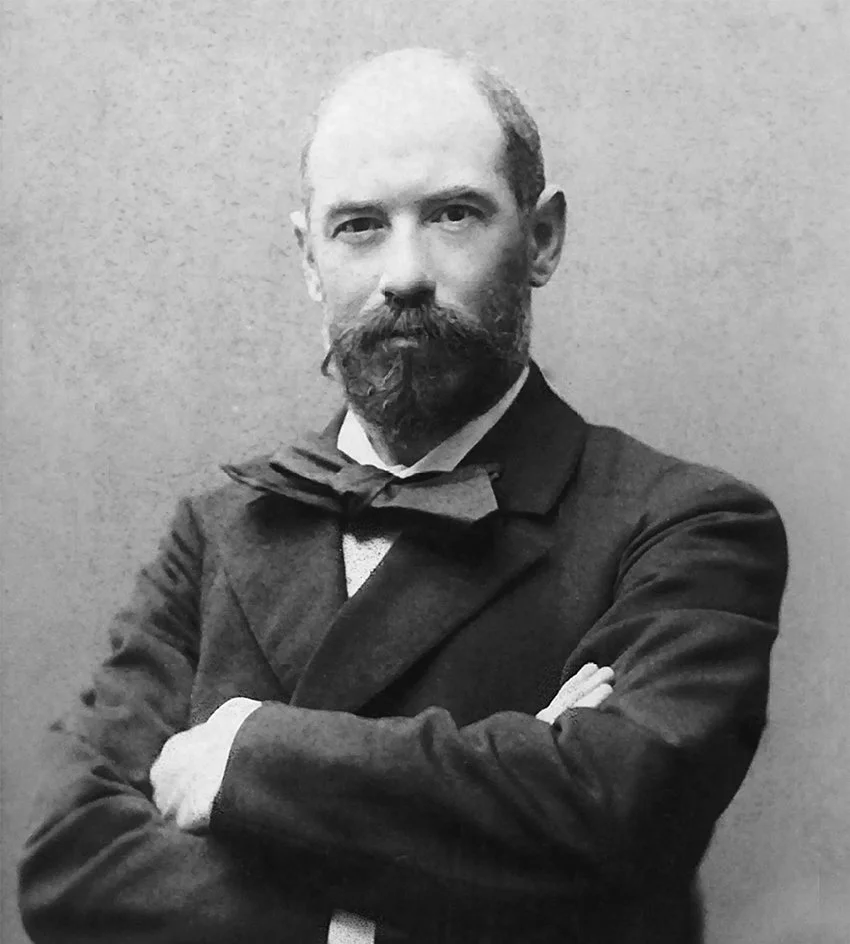
Konstanty Górski
Quick Facts
Born: 13 June 1859, Lida, then part of the Russian Empire—now Belarus
Died: 31 May 1924, Poznań, Poland
Life and Musical Career
Konstanty Antoni Górski was a Polish composer, violinist, conductor, organist and music teacher. Although highly respected during his lifetime, his music was largely forgotten after his death and has only recently begun to return to concert programmes and scholarly attention.
Górski studied at the Warsaw Institute of Music before continuing his education at the Saint Petersburg Conservatory. He graduated from the violin class of the distinguished Hungarian teacher Leopold Auer in 1881, receiving a silver medal and the title of “free artist”. He then studied composition and instrumentation with Nikolai Rimsky-Korsakov.
Following several years of performing and teaching in cities including Penza, Tbilisi and Saratov, Górski settled in Kharkiv in 1890. He remained there for nearly three decades, becoming an important figure in the city’s musical and Polish cultural life. He taught violin, conducted symphony orchestras and choirs, performed as a soloist and helped establish Polish cultural organisations. He was particularly admired as an interpreter of Pyotr Tchaikovsky’s Violin Concerto.
After the political upheaval of the Russian Revolution, Górski returned to newly independent Poland. He initially lived in Warsaw before moving to Poznań, where he worked as concertmaster of the Grand Theatre orchestra until his death in 1924.
His late-Romantic music includes operas, symphonic poems, sacred works, songs, organ music and compositions for violin. Three of his most important works are:
Organ Fantasy in F Minor – regarded as one of the finest works in Polish late-Romantic organ literature and still performed today.
Margier – a large-scale opera based on a historical poem by Władysław Syrokomla; it was staged by the Poznań Opera in 1927, three years after Górski’s death.
Missa Solemnis in E-flat Major – one of his principal sacred compositions, written for soloists, choir and orchestra and performed in Poland during the interwar period.
Sources:
Konstanty Górski Music Society — Biography of Konstanty Górski.
Konstanty Górski Music Society — Compositions of Konstanty Górski.
Research Library of the Polish Composers’ Union — Konstanty Górski: Scores and Recordings.