Quick Facts
Born: 1 March 1810, Żelazowa Wola, Duchy of Warsaw, now Poland
Chopin and his family used 1 March as his birth date, although his baptismal record states 22 February 1810.
Died: 17 October 1849, Paris, France
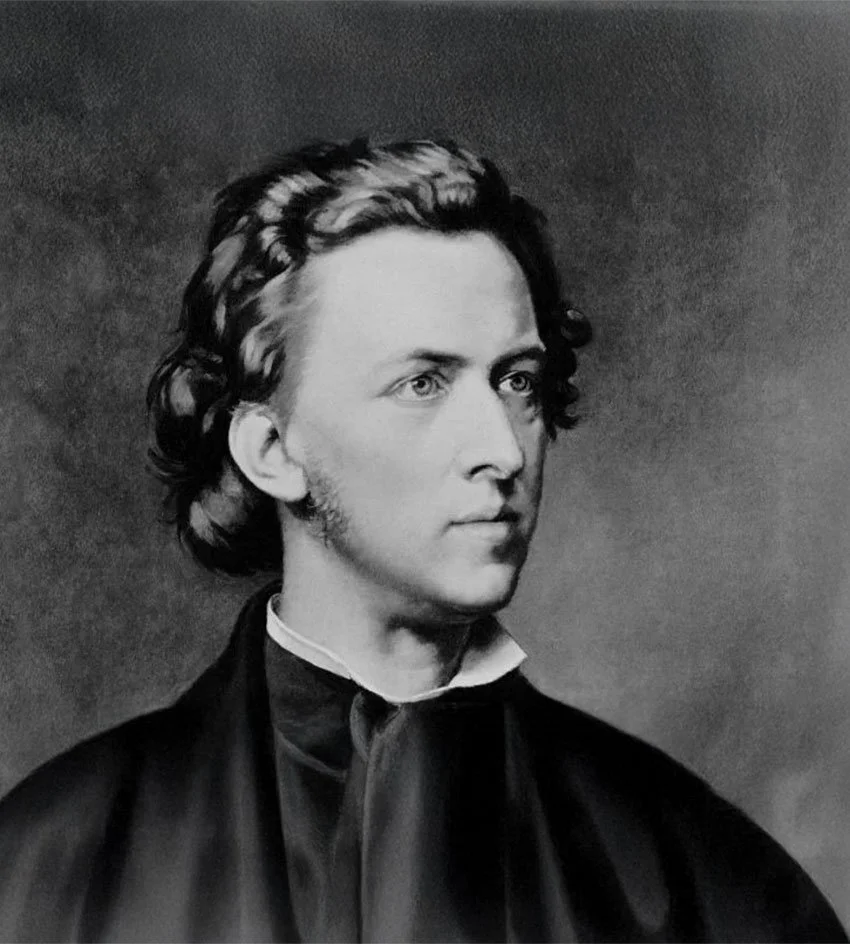
Life and Musical Career
Frédéric Chopin was a Polish composer and virtuoso pianist of the Romantic period. He is regarded as one of the most important composers for the piano, an instrument for which he wrote nearly all his compositions.
Born in Żelazowa Wola, Chopin moved with his family to Warsaw shortly after his birth. His musical talent appeared at an early age. He began composing as a child, published his first polonaise at the age of seven and performed in Warsaw’s aristocratic salons. He studied piano with Wojciech Żywny and later studied composition with Józef Elsner at the Warsaw School of Music. Elsner famously described him as an “extraordinary talent” and a “musical genius”.
Polish folk music strongly influenced Chopin’s style, particularly the rhythms and character of traditional dances such as the mazurka and polonaise. In 1830, he left Poland to develop his international career. Following the unsuccessful November Uprising against Russian rule, he settled permanently in Paris in 1831 and became closely connected with the Polish émigré community.
In Paris, Chopin gained recognition as a composer, pianist and highly sought-after teacher. He became acquainted with many leading artists, including Franz Liszt, Hector Berlioz and Eugène Delacroix. Unlike many virtuoso pianists of his era, Chopin preferred intimate salon performances to large public concerts. His music combined poetic expression, technical innovation, Polish national influences and a highly individual approach to melody, harmony and rhythm.
During his relationship with French writer George Sand, Chopin spent several productive summers at her home in Nohant. However, his health gradually deteriorated. He gave his final public performance in London in November 1848 and died in Paris the following year. He was buried at Père-Lachaise Cemetery, while his heart was returned to Warsaw and placed in the Church of the Holy Cross.
Three of his most important compositions are:
Piano Concerto No. 1 in E Minor, Op. 11 (1830) – a brilliant early work showcasing Chopin’s lyrical melodies and virtuoso piano writing.
Ballade No. 1 in G Minor, Op. 23 (1833) – a dramatic and emotionally powerful composition that demonstrates Chopin’s innovative approach to musical storytelling.
Polonaise in A-flat Major, Op. 53 (1843) – a majestic and technically demanding work that became a powerful musical symbol of Polish national identity.
Sources:
The Fryderyk Chopin Society — Fryderyk Chopin: Biography – General Outline.
The Fryderyk Chopin Society — Alphabetical List of Chopin’s Works.