Quick Facts
Born: 26 July 1928, Grodzisk Mazowiecki, Poland
Died: 2 September 1981, Warsaw, Poland
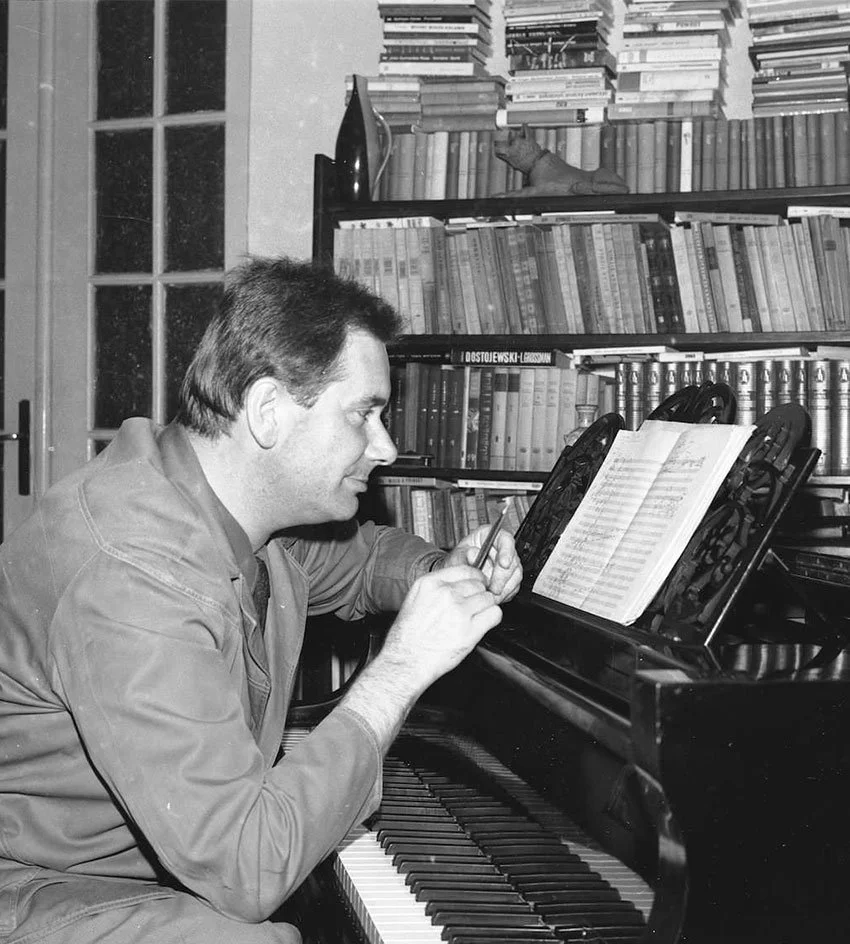
Life and Musical Career
Tadeusz Baird was a prominent Polish composer and educator associated with the post-war generation of contemporary Polish music. He began studying composition privately during the German occupation of Poland, working with Bolesław Woytowicz and Kazimierz Sikorski. After the Second World War, he continued his education at the State Higher School of Music in Warsaw, where he studied composition with Piotr Rytel and Piotr Perkowski. He also studied piano with Tadeusz Wituski and musicology at the University of Warsaw.
In 1949, Baird founded Group 49 with composers Kazimierz Serocki and Jan Krenz. The group aimed to create music that was modern yet accessible and emotionally expressive. Baird and Serocki were also among the founders of the Warsaw Autumn International Festival of Contemporary Music, first held in 1956. The festival became one of Central and Eastern Europe’s most important events dedicated to modern music.
Baird’s musical language combined modern techniques, including twelve-tone composition, with a strong respect for musical tradition. His works are known for their lyricism, carefully shaped melodies, emotional intensity and refined orchestral colours. Because of these characteristics, he was often described as a twentieth-century Romantic. Vocal and vocal-instrumental music held a particularly important place in his output, reflecting his deep interest in poetry, literature and theatre. He also composed symphonies, concertos, chamber music, film scores and music for theatrical productions.
In 1974, Baird began teaching composition at the State Higher School of Music in Warsaw. He became a full professor and head of its composition department in 1977. His music received numerous Polish and international awards, including three first prizes at UNESCO’s International Rostrum of Composers.
Three of his most important compositions are:
Four Essays for Orchestra (1958) – a landmark orchestral composition that received first prize at the UNESCO International Rostrum of Composers in 1959.
Four Love Sonnets (1956) – a deeply lyrical work for baritone and orchestra based on poems by William Shakespeare.
Four Dialogues for Oboe and Chamber Orchestra (1964) – an expressive instrumental work that received a UNESCO prize in 1966.
Sources:
Polskie Wydawnictwo Muzyczne — Tadeusz Baird: Biography.
Polish Music Center, University of Southern California — Tadeusz Baird: Biography and List of Works.
Culture.pl, Adam Mickiewicz Institute — Tadeusz Baird: Biography.